
WELCOME BONUS 300%
UP TO €2000 + 100
FREE SPINS
UP TO €2000 + 100
FREE SPINS
Home → Games
Casino games at Divas
37 vs. 38 Sectors: What the Double Zero Costs
American Roulette features 38 sectors, encompassing numbers 1 through 36, a single zero, and a double zero. This configuration results in a house edge of 5.26%, significantly higher than its European counterpart. The payout for a Straight bet remains 35:1, but the increased number of pockets directly impacts the player's theoretical return.
In contrast, French Roulette with inner bets (excluding La Partage) operates with 37 sectors, similar to European Roulette. The house edge on these bets is 2.70%, as the La Partage rule does not apply to inside wagers. This means the potential for larger losses exists compared to games where such rules are active.
The difference between 37 and 38 sectors directly translates to a higher cost for players opting for the American version. The additional double-zero sector increases the casino's advantage by 2.56 percentage points on all bets. This means for every €100 wagered on American Roulette, a player can expect to lose €5.26 on average, compared to €2.70 on French Roulette's inner bets.
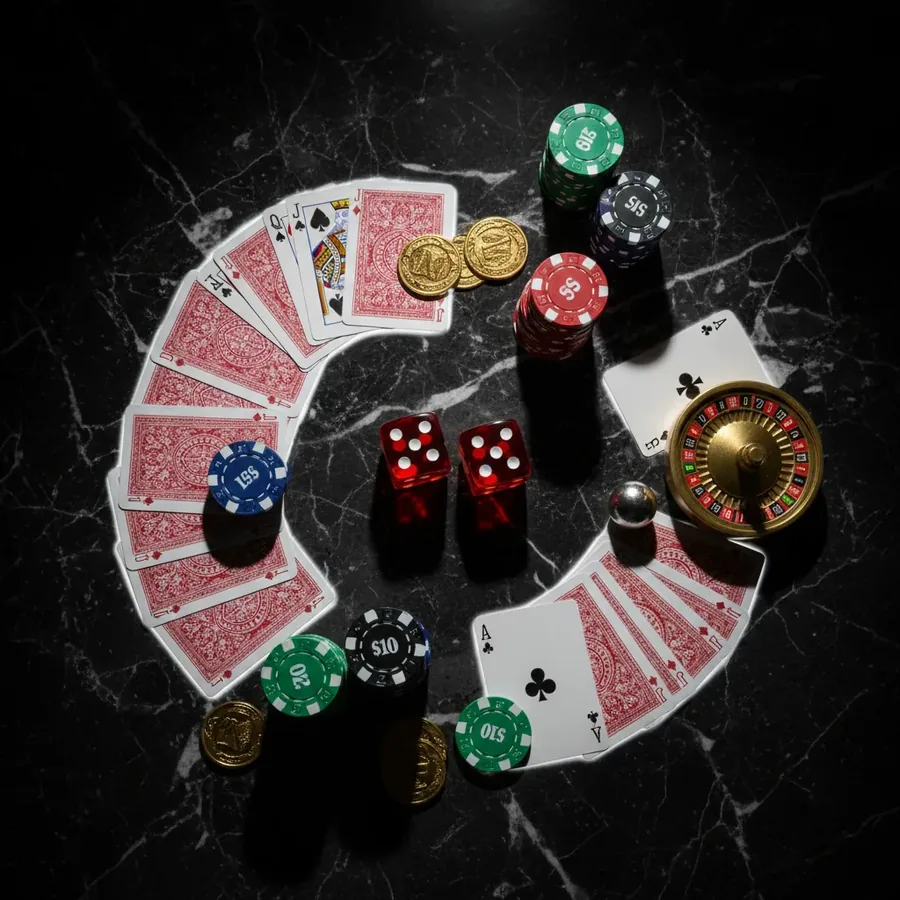
Hold or discard five cards: the decision
Video Poker games like Deuces Wild, specifically the 'Not So Ugly Ducks' (NSUD) variant, offer a return to player (RTP) of 99.73%, with a house edge of 0.27%. This game's strategy involves deciding which of the initial five dealt cards to hold and which to discard to form the best possible poker hand.
A 'Full Pay' version of Deuces Wild Video Poker is noted for an exceptional RTP of 100.76%, yielding a negative house edge of -0.76% for the player. This scenario is unique among mass-market games, provided optimal strategy and maximum bet are employed, making strategic card selection paramount for potential profit.
The player's decision on holding or discarding cards directly influences the outcome and potential winnings. For example, in Deuces Wild, holding two deuces in the initial hand can lead to a higher probability of forming a strong hand like Four of a Kind or a Wild Royal Flush, impacting the overall RTP from the 'Not So Ugly Ducks' variant.
RNG Roulette vs. Live Table: Four Clear Differences
Roulette in a Random Number Generator (RNG) format, such as French Roulette without La Partage, presents a house edge of 2.70% on inner bets. This digital environment offers immediate spin results, allowing for a high volume of play in a short period, distinct from the pace of a live dealer.
Live Table Roulette typically operates with similar rules to its RNG counterpart. For instance, American Roulette at a live table still features 38 sectors, leading to a 5.26% house edge. The interaction with a live dealer and other players introduces a different dynamic compared to the solitary experience of RNG games.
French Roulette with La Partage on even-money bets offers an RTP of 98.65%, with a 1.35% house edge. This rule, where half the stake is returned on a zero, is a significant differentiator. While RNG and live versions might offer the same rules, the perceived fairness and player engagement can vary substantially between the two formats.
When is Splitting Aces and Eights Sensible?
In Blackjack, the decision to split Aces and Eights is a strategic manoeuvre influenced by specific rules and deck composition. Splitting Aces is generally advisable as it allows for two potential starting hands with a high card value, improving the chances of forming strong hands.
Resplitting Aces (RSA) is a rule modifier that can improve RTP by 0.08 percentage points. This rule allows a player to split Aces even after they have already been split, further enhancing the potential for favourable outcomes when dealt Aces, particularly in combination with other favourable rules like Double After Split (DAS).
Splitting Eights is also a common recommendation in Blackjack strategy, especially when the dealer shows a weak upcard. The rationale is that two Eights do not form a strong starting hand (16 total), but splitting them into two hands of 8 offers a better chance of reaching 18 or higher, particularly when paired with liberal rules like S17 and DAS.
House Edge and RTP: Two Names for the Same Number
The House Edge represents the average percentage of each wager that the casino expects to retain over the long term. For example, American Roulette has a house edge of 5.26%, meaning that for every €100 wagered, the casino statistically expects to keep €5.26.
Return to Player (RTP) is the inverse of the house edge, indicating the theoretical percentage of wagered money that a player can expect to receive back over an extended period. Video Poker Deuces Wild – Full Pay boasts an RTP of 100.76%, implying a negative house edge of -0.76% for the player under optimal conditions.
While both terms relate to the casino's profitability and player's theoretical return, they are fundamentally two sides of the same coin. A 1.06% house edge in Baccarat Banker (with a 5% commission) corresponds directly to a 98.94% RTP for that bet, illustrating the direct mathematical relationship between the two metrics.
Game categories at a glance
| Category | Examples | Stakes From | Highlight |
|---|---|---|---|
| Slots | Major Millions, The Dog House, Money Train 4 | 0,10 EUR | thousands of titles |
| Table games | Roulette, Blackjack, Baccarat | 0,50 EUR | classic rules |
| Live casino | Quantum Roulette, Quantum Blackjack Plus Live | 0,20 EUR | real dealers |
| Jackpot games | Mega Moolah, Divine Fortune, Age of the Gods | 0,20 EUR | progressive pools |
| Instant games | Aviator, Plinko, Mines | 0,10 EUR | fast rounds |
| Video poker | Jacks or Better, Deuces Wild | 0,25 EUR | strategy based |
Multihand Blackjack with Up to 5 Hands
Blackjack Liberal Vegas Strip offers players the flexibility to play with up to five hands simultaneously. This variation features liberal rules with a 3:2 payout for a natural blackjack. The house edge is a competitive 0.28%, supported by favourable rules such as dealer hitting on soft 17, Double After Split (DAS), and the option of Late Surrender.
The standard deviation for this Blackjack variant is 1.15, indicating a moderate level of volatility. Players can benefit from favourable rule combinations, including hitting on soft 17, the ability to Double After Split, and the option to resplit cards. These elements contribute to the game's attractive RTP of 99.72%.
Playing multiple hands can increase the pace of the game and the potential for larger wins or losses within a session. However, it is crucial to remember that the stated RTP is a long-term theoretical average and does not guarantee returns for individual players, especially when managing multiple active hands.
What Doesn't Count Towards Bonus Wagering on Table Games?
Certain table game wagers do not contribute to the bonus wagering requirements. For instance, side bets in Baccarat, such as Player Pair and Banker Pair, are excluded. These bets have a higher house edge, with Player Pair at 10.36% and Banker Pair also at a significant rate, making them ineligible for bonus turnover.
Bets placed on Sic Bo, particularly the special bets like Triple, Double, and Single Number, also do not count towards bonus wagering. The house edge for these Sic Bo bets can range from 7.87% for Single Number bets up to 18.52% for Specific Double bets. Such high edges make them unsuitable for bonus contribution.
While table games generally contribute 10% towards bonus wagering, specific games and bet types may be excluded entirely. This exclusion policy is common to prevent players from exploiting bonus funds on games with lower house edges or volatile side bets, thereby ensuring fair play and responsible bonus usage.
Bankroll for 200 Rounds at 1 EUR
A bankroll of 200 EUR is sufficient for 200 rounds of play if each round is wagered at 1 EUR. This calculation is based on a simple multiplier of the wager amount by the number of rounds. For example, 1 EUR per round multiplied by 200 rounds equals a total wagered amount of 200 EUR.
This 200 EUR bankroll would cover 200 rounds of play at 1 EUR per round for games such as Baccarat Player or Banker bets, which have a low house edge of 1.24% and 1.06% respectively. These bets offer a straightforward 1:1 or 0.95:1 payout, making the bankroll management straightforward.
For games with higher volatility or a higher house edge, such as American Roulette with its 5.26% house edge, a 200 EUR bankroll might be depleted faster if each round involves a 1 EUR wager. The outcome of each round significantly influences the longevity of the bankroll, especially in games with less favourable odds.
6 Decks vs. 8 Decks in House Edge
The number of decks used in Blackjack can impact the house edge. For example, Blackjack with 6 decks, featuring a 6:5 payout for a natural blackjack, has a house edge of 1.85%. This is significantly higher than variations with a 3:2 payout, demonstrating the substantial effect of payout ratios.
Conversely, Blackjack Liberal Vegas Strip, played with 8 decks and a 3:2 payout, presents a much lower house edge of 0.28%. This highlights how favourable rules and payouts can mitigate the impact of a larger number of decks. The inclusion of DAS and Late Surrender further reduces the casino's advantage.
A difference of 2 decks, from 6 to 8, can contribute to a variance in the house edge, but it is often less impactful than changes in payout structures. For instance, the switch from a 3:2 to a 6:5 payout on blackjack adds approximately 1.39% to the house edge, a more significant factor than deck count alone.
Columns and Dozens Pay 2:1 in Roulette
In French Roulette without La Partage, bets on columns or dozens typically pay 2:1. This means for every 1 EUR wagered on a column or dozen, a winning bet will return 2 EUR in profit, plus the original stake. These bets cover 12 numbers each.
American Roulette also offers a 2:1 payout for column and dozen bets. However, due to the presence of both a single zero and a double zero (0 and 00), the house edge on these bets, and indeed on the entire game, is higher at 5.26%, compared to European or French Roulette's 2.70%.
The payout structure of 2:1 for columns and dozens is a standard feature across many roulette variants. The crucial difference for players lies in the overall house edge, which is significantly influenced by the presence of the double zero in American Roulette, making French or European roulette generally more favourable.
Roulette Wheel with 37 vs 38 Pockets
American Roulette features 38 pockets, including both 0 and 00, whereas European Roulette typically has 37 pockets with only a single 0. This additional pocket in American Roulette increases the house edge to 5.26%. In contrast, European Roulette with its single 0 pocket maintains a lower house edge of 2.70% for inside bets.
The payout for a Straight bet remains 35:1 across both variations of the wheel. However, the fundamental difference in the number of pockets directly impacts the probability of winning any given bet. A higher number of pockets inherently means more losing outcomes for the player over the long run.
For players seeking a more favourable statistical outcome, the European style wheel with 37 pockets offers a reduced house edge. This reduction directly translates to a higher theoretical Return to Player (RTP) of 97.30% for inside bets compared to the 94.74% RTP on American Roulette. This difference is critical for players focusing on game longevity.
Dozen 2:1: Twelve Numbers, One Third Coverage
Betting on a Dozen in Roulette covers twelve specific numbers, representing one-third of the total numbers on the wheel. In French Roulette, this bet typically pays 2:1, meaning a €10 stake returns €30. This payout ratio is consistent across both European and American versions of the game when considering the dozen bet specifically.
The house advantage on a Dozen bet in French Roulette, where La Partage does not apply to this bet type, is 2.70%. This is calculated based on the 37 numbered pockets in European Roulette. The payout of 2:1 for twelve numbers results in a theoretical RTP of 97.30%.
When comparing this to the American Roulette wheel with its 38 pockets, the house edge on a Dozen bet increases to 5.26%. This is due to the presence of the extra 00 pocket, which does not fall within any of the Dozen bets. Therefore, players on the American wheel have a lower RTP of 94.74% for this bet.
Straight, Split, and Corner in direct comparison
A Straight bet, also known as a single number bet, pays 35:1 in Roulette, offering the highest payout for a single outcome. A Split bet covers two adjacent numbers and pays 17:1, while a Corner bet covers four numbers and pays 8:1. These payouts are standard across most European Roulette variations.
The house edge for these inside bets in French Roulette, excluding the effect of La Partage, stands at 2.70%. This means that for every €100 wagered on these bet types, an average of €2.70 is retained by the casino over the long term. The RTP for these bets is therefore 97.30%.
In American Roulette, the presence of the double zero pocket increases the house edge for Straight, Split, and Corner bets. The RTP for these bets on an American wheel is 94.74%, reflecting the higher house edge of 5.26%. This makes inside bets statistically less favourable for players on the American version.
French Roulette: La Partage Lowers to 1.35 Percent
French Roulette introduces the La Partage rule, which specifically benefits even-money bets such as Red/Black, Odd/Even, and High/Low. When the ball lands on the single 0 pocket, half of the bet on these even-money options is returned to the player. This rule significantly reduces the casino's advantage on these specific wagers.
With the La Partage rule in effect for even-money bets, the house edge is reduced to 1.35%. This is a substantial decrease from the standard European Roulette house edge of 2.70%. Consequently, the RTP for these specific bets on French Roulette increases to 98.65%.
The En Prison rule, an alternative to La Partage in some French Roulette variants, offers a similar statistical benefit by allowing the bet to remain for the next spin. However, La Partage directly refunds 50% of the stake, providing a tangible immediate reduction in the house edge. For all other bets not covered by La Partage, the house edge remains at 2.70%.
Video Poker: check payout table before betting
Video Poker variations, such as Deuces Wild, can offer significantly different payout structures based on the specific paytable implemented by the casino. For instance, the 'Not So Ugly Ducks' (NSUD) variant of Deuces Wild features a specific set of payouts, including a Natural Royal at 800x and Four Deuces at 200x. This specific table results in a house edge of 0.27%.
The 'Full Pay' version of Deuces Wild, with a payout structure of 25/15/9/5/3/2/2/1, offers an RTP of 100.76%. This means that, theoretically, over an extended period and with optimal play, this game can return more than the initial wager. The house advantage here is a negative 0.76%, indicating a player advantage.
Players should always examine the paytable before commencing play, as deviations can dramatically alter the game's profitability. For example, the Illinois Deuces variation of Deuces Wild has a lower RTP of 98.91%, demonstrating how crucial checking the payout table is for maximizing potential returns and understanding the game's house edge.
Contact
Live - online chat
Banking









Providers












Divas Casino 2026